
AI-powered banking software
for co-operative banks in India
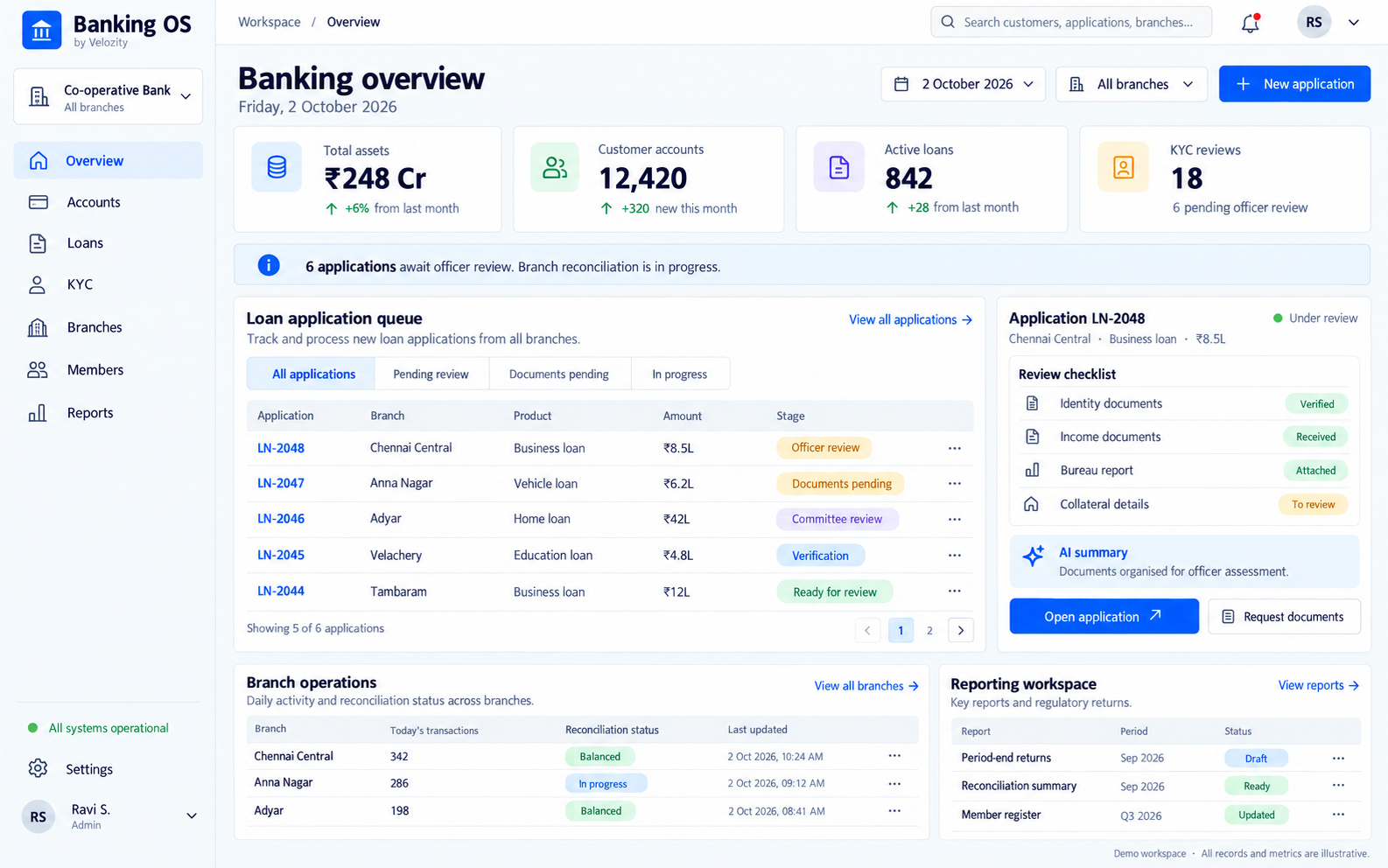
A modern core banking platform designed for urban and state co-operative banks. AI-driven loan processing, automated KYC verification, credit risk scoring, and RBI-compliant reporting. Multi-branch operations managed from a single dashboard.
What you are dealing with today.
Loan processing takes weeks instead of days
Manual document collection, physical verification, and committee approvals stretch loan turnaround to 10-14 days. Customers leave for faster alternatives. Loan officers spend most of their time on paperwork, not relationship building.
KYC and compliance are manual and error-prone
Staff manually verify Aadhaar, PAN, and address documents. Errors in data entry lead to RBI audit observations. Updating KYC records for existing customers is a never-ending backlog.
Legacy systems cannot support multi-branch operations
Older CBS platforms were designed for single-branch banks. Adding branches means maintaining separate databases, reconciling end-of-day manually, and dealing with inconsistent data across locations.
From setup to results.
Migrate or connect to Banking OS
We migrate your existing data from legacy CBS platforms or connect Banking OS alongside your current system during a transition period. Account data, loan portfolios, and customer records are mapped and validated.
Migration Dashboard
Phase 3 of 4Automate KYC and account opening
New customers complete KYC with Aadhaar-based e-KYC, PAN verification, and digital document upload. The system validates identity in real time and creates accounts in minutes instead of days.
KYC Pipeline
New Account| Applicant | Type | Aadhaar | PAN | CKYC | Status |
|---|---|---|---|---|---|
| MKMohan K. | Savings | Verified | Verified | Linked | Approved |
| SBSunita B. | Current | Verified | Pending | — | In Progress |
| RPRaj P. | FD | Verified | Verified | Linked | Approved |
Process loans with AI risk scoring
Loan applications are scored by AI based on income, repayment history, bureau data, and co-operative-specific parameters. Officers get a risk assessment and recommended terms. Committee approvals are digitised.
Loan Processing
| Applicant | Type | Amount | AI Risk Score | Status |
|---|---|---|---|---|
| MKMohan K. | Gold Loan | ₹5L | 92 Low risk | Approved |
| SBSunita B. | Personal | ₹2L | 68 Medium | Under review |
| RPRaj P. | Vehicle | ₹8L | 85 Low risk | Approved |
Generate RBI reports automatically
Statutory returns, SLR/CRR statements, NPA classification, and CRAR reports are generated automatically from live data. No more month-end scrambles to compile numbers manually.
Regulatory Reports
Generate All| Report | Frequency | Due Date | Status |
|---|---|---|---|
| DSB Return | Monthly | 30 Sep | Ready |
| SLR/CRR | Fortnightly | 28 Sep | Submitted |
| NPA Classification | Quarterly | 30 Sep | In Progress |
| ALM Statement | Monthly | 30 Sep | Ready |
What you get.
AI-powered loan processing
From application to disbursement in days, not weeks. AI scores creditworthiness, flags risks, and recommends loan terms. Digital document collection and e-signatures reduce paper handling.
Processing Speed
Automated KYC and e-KYC
Aadhaar-based e-KYC, PAN verification, and CKYC integration. Periodic KYC refresh reminders for existing customers. Reduces manual data entry errors and audit observations.
e-KYC Pipeline
Credit risk scoring
AI models trained on co-operative banking data assess borrower risk. Considers income stability, repayment history, guarantor strength, and sector-specific parameters. Supports both secured and unsecured lending.
Risk Model
RBI regulatory reporting
Automated generation of statutory returns including SLR/CRR, CRAR, NPA provisioning, large exposure reports, and priority sector lending returns. Data is always audit-ready.
Compliance Calendar
| Report | Due | Status |
|---|---|---|
| DSB Return | 30 Sep | Ready |
| SLR/CRR | 28 Sep | Submitted |
| BSR-1 | 15 Oct | Scheduled |
Multi-branch management
Real-time consolidation across all branches. Centralised product configuration, interest rate management, and user administration. Branch-level and consolidated dashboards.
Branch Network
| Branch | Accounts | Loans | Status |
|---|---|---|---|
| Main Branch | 4,200 | 280 | Online |
| City Branch | 3,800 | 240 | Online |
| Rural Branch | 4,420 | 322 | Online |
Member and share management
Purpose-built for co-operative banks: member enrollment, share capital management, dividend processing, and voting rights tracking. Supports the co-operative governance model.
Member Services
Watch a quick demo.
Banking OS in 60 seconds.
What it looks like in practice.
12-branch urban co-operative bank in Maharashtra
Loan processing averaged 14 days from application to disbursement. KYC verification was entirely manual, with staff photocopying documents and entering data by hand. RBI audit observations on KYC gaps were increasing year over year.
KYC verification time reduced by 70% with Aadhaar-based e-KYC. RBI audit observations on KYC dropped to zero in the first annual inspection after deployment. Loan officers now handle 40% more applications per month.
"Our members used to joke that getting a loan from us took longer than from a private bank. Now we are faster, and our members are staying instead of moving to fintech lenders." — One year after full rollout.Prakash Deshmukh, General Manager, Urban Co-operative Bank
Works with your existing tools.
Enterprise-ready from day one.
Deployment options
- Cloud-hosted SaaS accessible from any branch
- On-premise deployment for banks preferring local data storage
- Hybrid: local database with cloud backup and disaster recovery
- Supports concurrent users across all branches
- Mobile banking module for customer-facing services
Security and compliance
- Data encrypted at rest and in transit
- Role-based access with maker-checker workflows
- Full audit trail for all transactions
- RBI IT framework and cybersecurity guidelines followed
- Data hosted in Indian data centres with DR setup
Clear pricing. No surprises.
Pricing depends on your team size, deployment, and support needs.
Single-branch deployment. Multi-branch pricing from ₹1,20,000/month. Includes core banking, lending, KYC, and RBI reporting. Implementation and data migration quoted separately. GST extra.
INCLUDES
- Core banking (deposits, withdrawals, transfers)
- Loan processing with AI risk scoring
- KYC automation and e-KYC
- RBI regulatory reporting
- Multi-branch consolidation
- Email and phone support
Built for specific needs.
Good fit
- Urban co-operative banks with 1-50 branches
- State co-operative banks modernising their CBS
- Credit co-operative societies scaling operations
- Co-operative banks preparing for RBI digital lending guidelines
- Banks where loan processing takes more than 7 days
Not designed for
- Scheduled commercial banks (they typically use Tier-1 CBS vendors)
- Microfinance institutions with group lending models (needs a specialised MFI platform)
- Banks looking only for a mobile banking app without core banking replacement
- SHG federations and NBFC-MFIs
How much does Banking OS cost for a multi-branch bank?+
Single-branch deployment starts at ₹75,000 per month. Multi-branch pricing starts at ₹1,20,000 per month and scales based on the number of branches, users, and transaction volume. Implementation and data migration are quoted separately.
How long does implementation take?+
A single-branch deployment is typically live within 8-10 weeks, including data migration, testing, and staff training. Multi-branch rollouts are phased, with each additional branch taking 2-3 weeks.
Is it compliant with RBI guidelines for co-operative banks?+
Yes. Banking OS follows RBI guidelines for urban co-operative banks including IT framework requirements, cybersecurity guidelines, and statutory reporting formats. The system is updated as RBI circulars are issued.
Can it connect to NEFT, RTGS, IMPS, and UPI?+
Yes. Banking OS integrates with NPCI payment systems for NEFT, RTGS, IMPS, and UPI. Your bank can offer digital payment services to members through the platform.
How does the AI loan scoring work?+
The AI model considers income documentation, repayment history, credit bureau data (CIBIL, Equifax, CRIF), guarantor assessment, and sector-specific risk parameters. It produces a risk score and recommended terms that the loan committee can review and approve or override.
Does it handle NPA classification and provisioning?+
Yes. The system automatically classifies assets as standard, sub-standard, doubtful, or loss based on RBI norms. Provisioning requirements are calculated automatically and reflected in regulatory reports.
What about AML compliance?+
Banking OS includes basic transaction monitoring and suspicious activity flagging. For comprehensive AML with real-time monitoring and FIU-IND reporting, we offer AML Transaction Monitoring as a dedicated module. For broader regulatory compliance tracking, see Compliance OS
Can we migrate from our existing CBS?+
Yes. We have experience migrating data from legacy CBS platforms commonly used by co-operative banks. The migration process includes data validation, parallel running, and reconciliation before go-live.
Related guides.
AML compliance in India with AI automation
How AI reduces false positives and speeds up suspicious transaction reporting.
Read the guideFrom AI prototype to production
What changes when you move from demo to daily use in a regulated environment.
Read the guideEnterprise knowledge that stays useful
How to build knowledge systems that your banking staff actually use.
Read the guideBanking OS.
Let's set it up.
Book a 20-minute demo, get a quote, or just ask a question.
Our team in Chennai responds within one working day.