
AML transaction monitoring
software for India
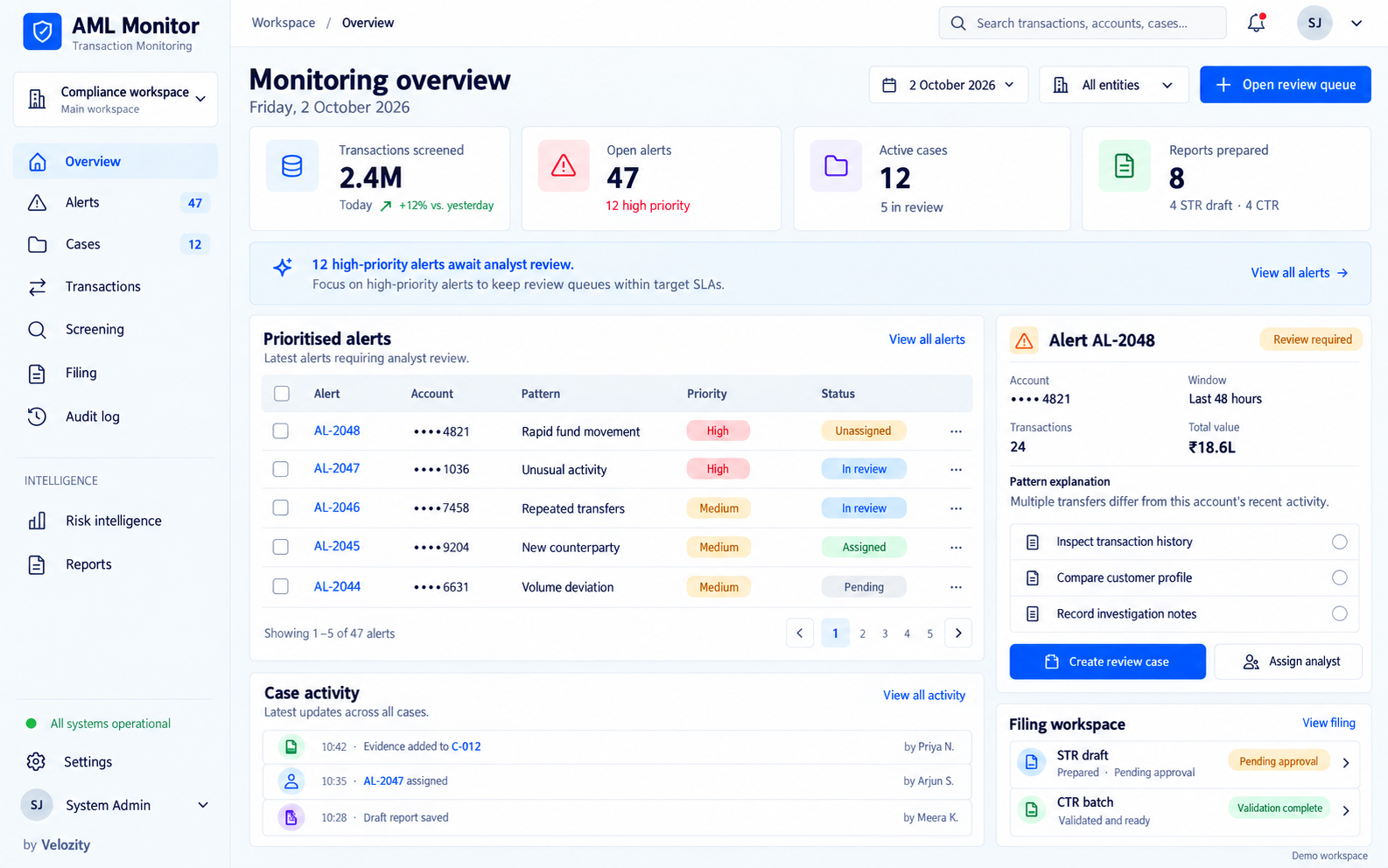
Real-time transaction monitoring that detects suspicious activity, reduces false positives with AI, and automates STR/CTR filing for FIU-IND. Built for Indian banks, NBFCs, and payment aggregators handling high transaction volumes under PMLA regulations.
What you are dealing with today.
Rule-based systems generate 90%+ false positives
Legacy AML systems use rigid rules that flag thousands of legitimate transactions. Compliance teams spend most of their time clearing false alerts instead of investigating genuine risks.
STR filing is manual and deadline-driven
Suspicious Transaction Reports must be filed with FIU-IND within prescribed timelines. Manual report preparation is slow, error-prone, and creates compliance risk if deadlines are missed.
Transaction patterns evolve faster than static rules
Money laundering methods change constantly. Static rule sets cannot detect novel structuring patterns, layering through digital wallets, or mule account networks without frequent manual updates.
From setup to results.
Connect your transaction data feeds
Integrate Banking OS, core banking system, payment gateway, or UPI switch via API or batch file upload. The system ingests transactions in real time or near-real-time depending on your infrastructure.
Transaction Sources
All connected| Source | Type | Volume/Day | Status |
|---|---|---|---|
| Core Banking | Real-time | 180K txns | Live |
| UPI Gateway | Real-time | 1.2M txns | Live |
| NEFT/RTGS | Batch | 45K txns | Live |
| Card Network | Real-time | 980K txns | Live |
AI models analyse transactions in real time
Machine learning models score every transaction for suspicious patterns. Models detect structuring, rapid movement, unusual geography, dormant account activation, and network-level anomalies. Rules and AI work together.
AI Analysis
Scanning| Account | Pattern | Amount | AI Score | Status |
|---|---|---|---|---|
| #48210 | Structuring | ₹6.86L | 94 | Critical |
| #31205 | Rapid movement | ₹12.4L | 88 | High |
| #22018 | Round-tripping | ₹8.2L | 72 | Medium |
Compliance team reviews prioritised alerts
Alerts are ranked by risk score so analysts investigate the most suspicious cases first. Each alert includes transaction details, customer profile, pattern explanation, and suggested action. False positives are drastically reduced.
Case Management
Create Case| Case | Alert Type | Value | Assigned | Status |
|---|---|---|---|---|
| CASE-0842 | Structuring | ₹6.86L | ASAmit S. | Investigating |
| CASE-0841 | Rapid movement | ₹12.4L | NRNeha R. | STR Draft |
File STRs and CTRs with FIU-IND
Generate Suspicious Transaction Reports and Cash Transaction Reports in FIU-IND prescribed formats. File directly or export for upload. Maintain complete audit trails for regulatory examinations.
FIU-IND Filing
File STR| Filing | Type | Date | Status |
|---|---|---|---|
| STR-2026-0842 | Suspicious Transaction | 24 Sep | Draft |
| CTR-2026-0918 | Cash > ₹10L | 23 Sep | Filed |
| STR-2026-0838 | Structuring | 20 Sep | Acknowledged |
What you get.
AI-powered transaction scoring
Every transaction receives a risk score based on AI analysis of amount, frequency, counterparty, geography, and historical behaviour. Suspicious patterns are detected even when individual transactions look normal.
Model Performance
Dramatically fewer false positives
AI models learn from analyst feedback to distinguish genuine risk from benign activity. Organisations typically see false positive rates drop from 85-95% to 10-20% within the first quarter of deployment.
Alert Quality
Automated STR and CTR filing
Generate STR and CTR reports in FIU-IND prescribed XML formats. Pre-populated fields, validation checks, and one-click filing reduce report preparation time from hours to minutes.
Filing Automation
Network analysis and mule detection
Graph-based analysis maps transaction networks to identify mule account chains, circular flows, and layering patterns that individual transaction rules would miss.
Mule Detection
Graph analysis detected hidden connections not visible in individual transaction review.
Real-time and batch processing
Process transactions in real time for instant alerts on high-risk events, or in batch mode for end-of-day analysis. Hybrid processing balances speed with system resources.
Throughput
Sanctions and PEP screening
Screen customers and counterparties against UN, OFAC, EU, and Indian MHA sanctions lists. Politically Exposed Person (PEP) identification with fuzzy name matching and alias detection.
Screening
| List | Records | Last Updated | Status |
|---|---|---|---|
| OFAC/SDN | 12,400 | Today | Active |
| UN Sanctions | 8,200 | Today | Active |
| India PEP | 24,800 | Today | Active |
Watch a quick demo.
AML Transaction Monitoring in 60 seconds.
What it looks like in practice.
Payment aggregator in Bangalore processing 2 crore+ transactions per month
The existing rule-based AML system generated a 92% false positive rate, overwhelming the 8-person compliance team. Analysts spent most of their time clearing legitimate alerts. STR filing was manual, taking 3-4 hours per report, and deadlines were frequently at risk.
STR filing time reduced by 80% with automated report generation. The compliance team now spends the majority of their time on genuine investigations. Two previously undetected mule account networks were identified within the first month.
"We went from drowning in false alerts to actually doing the compliance work that matters. The AI caught patterns our rules never would have flagged, including a mule network moving funds through 40+ accounts." — After the first quarter.Ananya Reddy, Chief Compliance Officer, Payment Aggregator
Works with your existing tools.
Enterprise-ready from day one.
Deployment options
- Cloud-hosted SaaS with Indian data centres
- On-premise deployment for banks requiring local processing
- Hybrid: on-premise transaction processing with cloud analytics
- Scales from 1 lakh to 10+ crore transactions per month
- Multi-entity support for banking groups
Security and compliance
- Data encrypted at rest and in transit with AES-256
- Role-based access with maker-checker workflows
- Complete audit trail for every alert, investigation, and filing
- Compliant with PMLA, RBI KYC/AML guidelines, and FIU-IND requirements
- Data hosted in Indian data centres with disaster recovery
Clear pricing. No surprises.
Pricing depends on your team size, deployment, and support needs.
For up to 1 lakh transactions per month. Volume-based pricing for higher transaction volumes. Includes all detection models, alerts, and FIU-IND filing. GST extra.
INCLUDES
- Real-time transaction monitoring
- AI-powered risk scoring
- STR and CTR report generation
- Sanctions and PEP screening
- Alert management dashboard
- Quarterly model tuning and support
Built for specific needs.
Good fit
- Urban and state co-operative banks under RBI AML guidelines
- Payment aggregators and fintech companies with high transaction volumes
- NBFCs with lending and payment operations
- Banks with high false positive rates in existing AML systems
- Organisations preparing for RBI AML/CFT inspections
Not designed for
- Businesses not regulated under PMLA or RBI AML guidelines
- Very small banks processing fewer than 10,000 transactions per month (manual monitoring may suffice)
- Companies looking only for KYC without transaction monitoring
- Crypto exchanges (specialised crypto-AML tools are more appropriate)
Common questions about AML Transaction Monitoring.
Something not covered here? Talk to our team.
How much does AML Transaction Monitoring cost?+
Pricing starts at ₹95,000 per month for up to 1 lakh transactions. For higher volumes, pricing is based on monthly transaction count. A payment aggregator processing 2 crore transactions per month would receive custom volume pricing. Contact us for a quote.
How long does deployment take?+
Typical deployment takes 6-8 weeks, including data integration, model calibration with your historical transaction data, rule configuration, and compliance team training. Banks with complex legacy systems may take 10-12 weeks.
How does it reduce false positives?+
AI models learn patterns from your transaction data and analyst feedback. Instead of rigid threshold-based rules, the system scores transactions holistically. Most organisations see false positive rates drop by 70-80% within the first 90 days.
Is it compliant with PMLA and RBI guidelines?+
Yes. The system is designed to meet Prevention of Money Laundering Act (PMLA) requirements and follows RBI Master Direction on KYC/AML/CFT. STR and CTR reports are generated in FIU-IND prescribed formats.
Can it handle UPI and digital wallet transactions?+
Yes. The system processes UPI, wallet, NEFT, RTGS, IMPS, cash, and card transactions. AI models are trained to detect patterns specific to each payment channel, including micro-structuring through UPI.
Does it integrate with our core banking system?+
Yes. We integrate with major CBS platforms used by co-operative banks and NBFCs via API or file-based feeds. If you use Banking OS, integration is built in. For regulatory compliance management beyond AML, see Compliance OS
How often are the AI models updated?+
Models are tuned quarterly based on new transaction patterns and analyst feedback. Major model updates are deployed when significant regulatory changes or new typologies emerge. You can also request ad-hoc tuning.
What happens during an RBI inspection?+
The system maintains a complete audit trail of every alert generated, investigation performed, and report filed. Inspection-ready reports showing system effectiveness, alert resolution times, and STR filing compliance are available on demand.
Related guides.
AML compliance in India with AI automation
How AI reduces false positives and speeds up suspicious transaction reporting.
Read the guideHuman review in agentic workflows
Why human oversight matters in AI-driven compliance decisions.
Read the guideFrom AI prototype to production
What changes when you move from a compliance demo to a live system.
Read the guideAML Transaction Monitoring.
Let's set it up.
Book a 20-minute demo, get a quote, or just ask a question.
Our team in Chennai responds within one working day.